
ISO 19650 explained: the global standard behind BIM
If BIM is the language, ISO 19650 is the grammar.
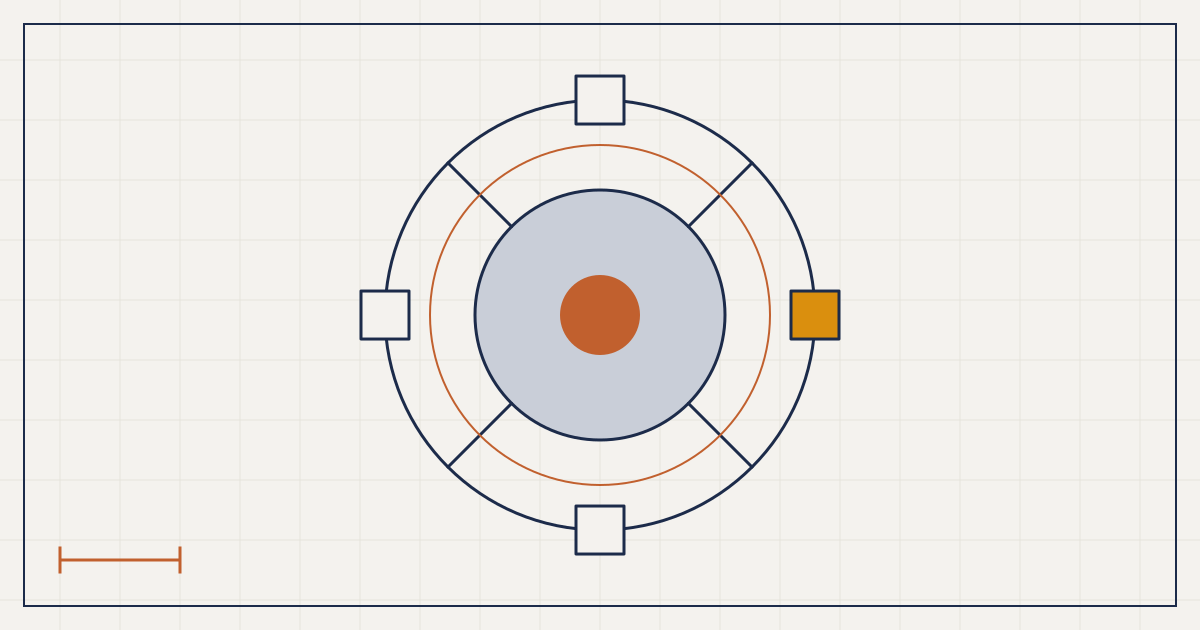
ISO 19650 is the international standard series for organising and managing information about built assets using BIM. It defines roles, a common data environment, information requirements and delivery processes across design, construction and operation. Indian projects typically reference it directly.
Why a global standard
BIM grew out of local practice. In the UK, PAS 1192 laid the groundwork for managing construction information. As the industry went global, national guidelines diverged, and inefficiency and interoperability problems followed. ISO 19650 took the best of those local standards and made a flexible but rigorous framework that works across borders. I have seen first-hand what structured information workflows do for a project, and I believe this standard will shape how buildings are delivered for decades.
How the standard is organised
ISO 19650 is a series of parts, not a single document:
- Part 1, concepts and principles. Defines the common data environment (CDE), the information delivery cycle and the roles: appointing party, lead appointed party and task teams.
- Part 2, delivery phase of assets. Sets the process for design and construction: information requirements, appointing an information manager, and a standard route to create, share and approve information.
- Part 3, operational phase. Carries the same discipline into operation, so owners and facility managers can keep their information alive.
- Part 4, information exchange. Covers checking and exchanging information.
- Part 5, security-minded approach. Addresses protecting sensitive built-asset information.
- Part 6, health and safety. Covers information that supports health and safety.
Key vocabulary
- CDE: the managed digital space where information is stored, shared and approved.
- EIR: exchange (or employer's) information requirements, what the client needs delivered.
- AIR and PIR: asset and project information requirements.
- BEP: BIM execution plan, how the team will deliver.
- Level of information need: how much geometry, data and documentation is needed, for what purpose.
Why it matters
Collaboration across borders. Teams in different countries can use the same vocabulary and process.
Efficiency. Misunderstandings and rework are among the biggest causes of overruns. A shared process reduces both.
Risk and compliance. Public clients increasingly ask for ISO 19650-aligned delivery. Following it reduces legal and commercial risk from incomplete or inconsistent data.
Lifecycle value. Structured information at handover supports operations, digital twins and predictive maintenance.
What about India?
As far as we can tell, there is no published Indian Standard that covers BIM information management, so Indian BIM projects reference ISO 19650 directly. The same gap exists one level down, in the content of manufacturers' BIM objects. That is the gap AS 1:2026 is written to address, complementing ISO 19650 rather than replacing it.
Five practical steps to implement it
- Train your team. It is a cultural shift as much as a technical one.
- Set up a CDE. Structured folders, naming, status codes and approvals, in a tool the whole team can use.
- Define information requirements. Write down who needs what, when, and in what form.
- Write a BEP. Roles, deliverables, quality checks.
- Automate the routine. Use cloud platforms and validation tools to remove manual errors.
A framework for the future
ISO 19650 is more than a compliance exercise. It is a framework for working smarter, reducing risk and unlocking what BIM can do. Firms that adopt it early will be better prepared for whatever clients and regulators ask next.
Key takeaways
- ISO 19650 is a series of standards, not one document.
- Its centre is the CDE, clear roles and defined information requirements.
- It covers design, construction and operation.
- Indian projects usually reference it directly.
- Start with training, a CDE and a simple BEP.
Questions people ask
What is ISO 19650?
ISO 19650 is the international standard series for organising and managing information about buildings and civil engineering works using BIM, across their whole lifecycle.
What is a common data environment?
A CDE is the agreed digital space where project information is stored, shared, reviewed and approved under defined rules.
Is ISO 19650 mandatory in India?
As far as we can tell there is no Indian Standard on BIM information management, and Indian projects reference ISO 19650 directly where a client asks for it. Always check the contract and client requirements.
The standard one level down
ISO 19650 governs project information. AS 1:2026 governs what a manufacturer's BIM object must contain. Read it free.
Download AS 1:2026 (PDF)Keep reading
The levels of BIM, from Level 0 to Level 3, explained
Everyone says they do BIM. The levels tell you how much of it they actually do.
BIM 101: the principles every designer and engineer should know
BIM is not a tool you install. It is a way of thinking about buildings, and the earlier you get that, the more it pays you back.
Facility management with BIM: how digital twins are changing operations
A building's life is mostly operation. A digital twin finally gives that life a data model.