
Facility management with BIM: how digital twins are changing operations
A building's life is mostly operation. A digital twin finally gives that life a data model.
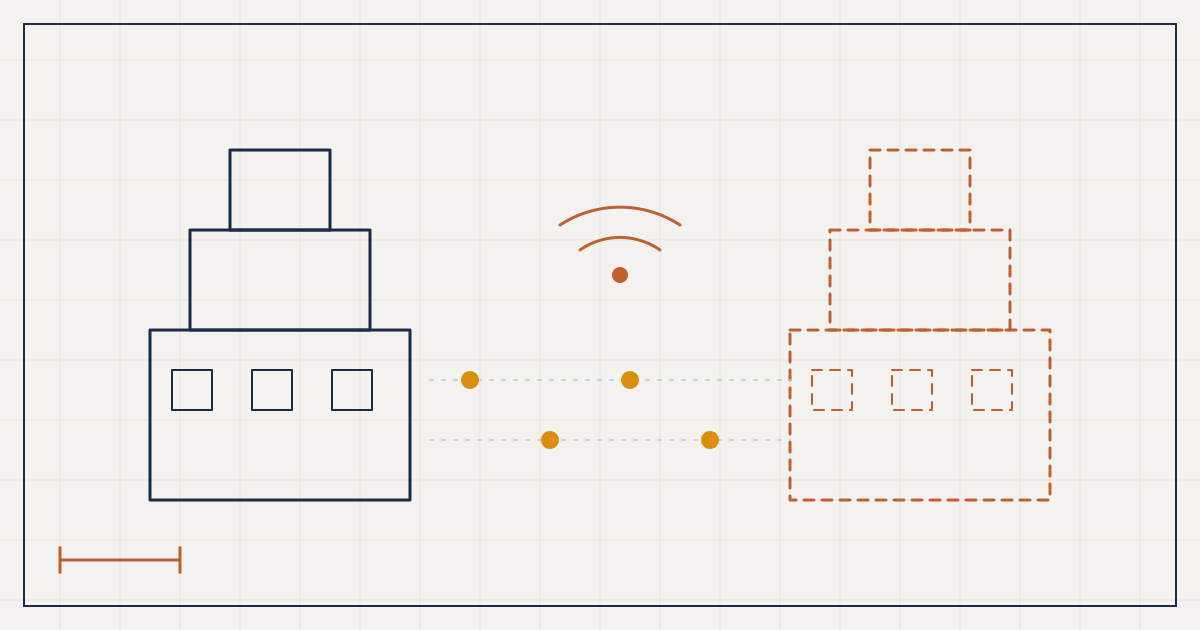
A digital twin is a BIM-based virtual replica of a building that is continuously updated with live data from sensors and facility systems. It lets facility teams move from fixing problems after they appear to predicting and preventing them, but it only works if handover data is accurate and structured.
The shift towards intelligent operations
For decades facility management has been burdened by ageing infrastructure, reactive maintenance and a lack of real-time information. As a BIM researcher, I have watched this change first-hand: real-time data, predictive analytics and automation are letting facility managers move from reacting to anticipating.
What is a digital twin?
A digital twin is a virtual copy of a physical building that is kept up to date with data from sensors, IoT devices and facility software. A design-stage BIM model is static. A twin evolves with the building.
- 3D BIM model: geometry and asset information as the foundation.
- Sensor integration: live data on temperature, occupancy, energy and condition.
- Analytics and AI: pattern detection, failure prediction and maintenance suggestions.
- Cloud connectivity: access for managers, engineers and service providers wherever they are.
Five practical benefits
1. Predictive maintenance
Instead of waiting for a pump to fail, analytics watch vibration, temperature and run-hours, and flag the pump that is drifting. Maintenance is scheduled on evidence, not on a calendar or a breakdown.
2. Energy and sustainability
Real-time consumption data shows where energy is wasted. Buildings such as The Edge in Amsterdam are often cited for adjusting lighting and climate to occupancy through sensor data.
3. Space use
Occupancy analytics show which spaces are used, when, and by how many people, so layouts and leases can follow reality.
4. Safety and emergency response
In an incident, live information on systems, exits and hazards supports faster decisions. Twins can also be used to rehearse emergency scenarios in a risk-free virtual setting.
5. Asset management
Every pump, door and luminaire has a record: what it is, who made it, when it was installed, what it needs. That history lives with the asset instead of in someone's memory.
Honest challenges
- Investment. IoT, cloud and analytics cost money to set up.
- Security. Continuous data collection widens the attack surface.
- Skills. Facility teams need training to use the data well.
- Data quality at handover. If the as-built model holds generic or missing product data, the twin starts with a weak foundation.
Where it is going
Expect more autonomous operation, tighter links to smart-city systems and standard protocols that let twins from different vendors talk to each other.
The inevitable future of facility management
The move from traditional facility management to data-driven operation is not a distant idea. It is happening. Buildings of the future will not just be designed intelligently. They will operate intelligently too, and the teams who prepare their data now will be the ones ready for it.
Key takeaways
- A digital twin is a living, sensor-fed version of the BIM model.
- The big wins are predictive maintenance, energy, space use, safety and asset records.
- Cost, security and skills are real barriers.
- A twin is only as good as the product and asset data handed over at completion.
Questions people ask
What is a digital twin in facility management?
It is a virtual replica of a building, built on a BIM model and updated with live data from sensors and systems, used to monitor, predict and optimise how the building performs.
How is a digital twin different from a BIM model?
A BIM model is usually a snapshot made for design and construction. A digital twin stays connected to the real building and changes as the building changes.
What data does a twin need from manufacturers?
Accurate product identity, warranty and maintenance information, and for advanced cases a live data connection. AS 1:2026 Levels 3 and 4 describe lifecycle data and live-data readiness for exactly this.
Handover data starts with the product
AS 1:2026 Level 3 asks for maintenance and lifecycle data, and Level 4 for a live data connection. Read the standard, free.
Download AS 1:2026 (PDF)Keep reading
How clash detection in BIM saves money on site
A clash on screen costs minutes. The same clash on site costs walls, weeks and trust.
ISO 19650 explained: the global standard behind BIM
If BIM is the language, ISO 19650 is the grammar.
The levels of BIM, from Level 0 to Level 3, explained
Everyone says they do BIM. The levels tell you how much of it they actually do.