
How clash detection in BIM saves money on site
A clash on screen costs minutes. The same clash on site costs walls, weeks and trust.
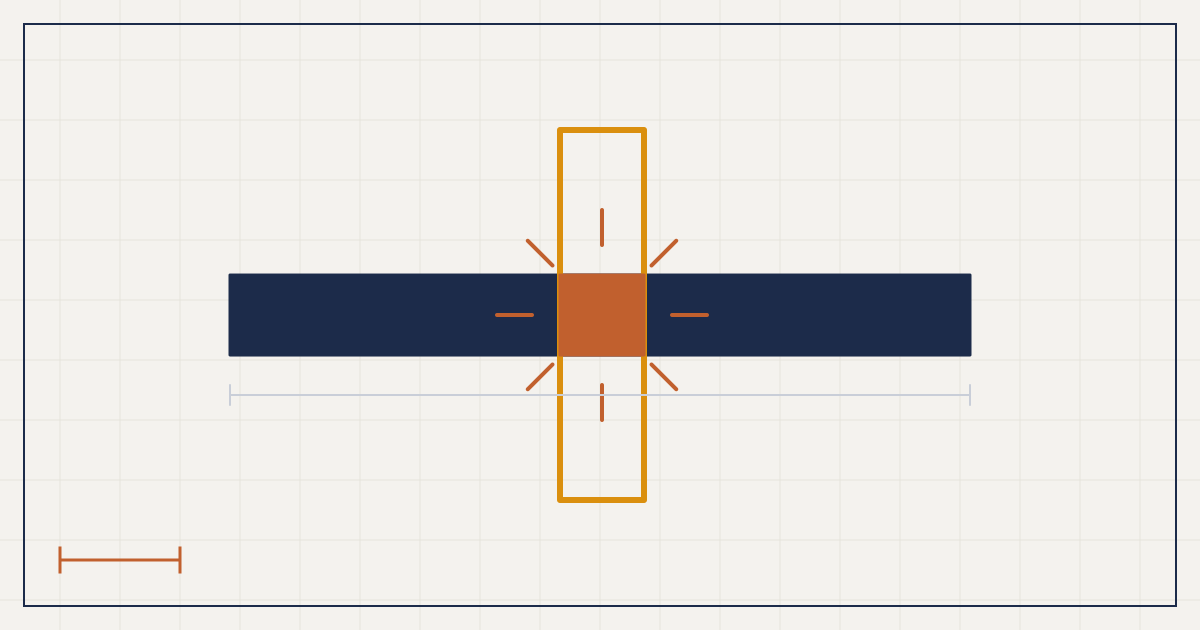
Clash detection combines architectural, structural and MEP models and automatically finds where elements collide or violate clearances. One published design-build case reported $2.55 million in net savings on a $200,000 coordination effort. Done early and regularly, it is among the highest-return uses of BIM.
The problem it solves
A construction project brings together architects, structural engineers, MEP designers, fire consultants and civil teams. Each works in their own model, and each model makes sense alone. Combine them and they start fighting for the same space. Historically those fights were discovered on site, with the crew standing under the problem. Rework, waste and delay followed.
BIM-based clash detection moves the fight to a screen, before any material is bought.
Three kinds of clash
- Hard clashes. Two physical elements occupy the same space, such as a steel beam and an HVAC duct.
- Soft clashes. An element violates required clearance, for example no room to maintain or replace a unit.
- Workflow clashes. Scheduling conflicts, such as two trades programmed into the same area at the same time. These show up when the model is linked to the programme (4D).
What the evidence says
Two sources are worth knowing.
A design-build food facility in California. The contractor, Haskell, analysed a $230 million project in a case study published by the Design-Build Institute of America. For about $200,000 of coordination effort, the team reported $2.22 million in avoided rework and a conservative $542,000 in schedule savings from one month less of site overheads. That works out to roughly $2.55 million in net savings, a 10x return on the coordination labour.
An academic cost-benefit study. Researchers (Chahrour et al., 2021, Construction Management and Economics) built a method for costing clashes by who is involved and what action is needed. Applied to a multi-million-dollar project, it estimated savings of about 20% of contract value, an estimate based on what the unresolved clashes would have cost if found on site.
Neither figure is a promise for your project. Savings depend on project type, how early coordination starts and how disciplined the process is. But the direction is consistent: the earlier a clash is found, the cheaper it is.
How to run clash detection well
- Start early. Coordinate at design development, not after drawings are issued.
- Federate regularly. Weekly or fortnightly runs beat one big check.
- Agree tolerances. Decide what counts as a clash, including clearances for access and maintenance.
- Triage and assign. Group results, give each issue an owner and a date, and close them in a visible log.
- Re-run after every fix. Fixes create new clashes.
Garbage in, garbage out
Clash detection is only as honest as the objects in the model. If the air handling unit is a generic box, you get generic answers: the real unit has a service panel that swings out, a drain connection and a weight that changes the structure. This is why manufacturer-authored, data-rich objects matter. Accurate geometry and clearances inside the object are what turn a clash report from a rough warning into a reliable decision.
Where it is heading
Cloud models, AI-assisted triage and generative design are moving clash detection from "find and report" towards "suggest and resolve". The principle stays the same: find the problem while it is still cheap to fix.
Final thoughts
Construction is moving towards a world where mistakes are anticipated, not discovered. Clash detection is the clearest, most measurable step on that road. The data is there and the case studies are credible. The only question is whether you run it before the site, or after.
Key takeaways
- Clashes are hard (physical), soft (clearance) or workflow (scheduling).
- A published case reported about $2.55 million net savings from roughly $200,000 of coordination.
- An academic study estimated savings near 20% of contract value on one large project.
- Start early, check often, assign owners and re-run after every fix.
- Accurate product objects make clash results trustworthy.
Questions people ask
What is clash detection in BIM?
Clash detection is the automated checking of a combined building model for conflicts between elements, such as a duct passing through a beam, or insufficient clearance around equipment.
Which software runs clash detection?
Autodesk Navisworks and Solibri are widely used. Many authoring and cloud platforms also offer coordination tools.
When should clash detection happen?
As early as the disciplines have models to combine, and then regularly through design development. Late clash detection still helps, but the savings shrink as work gets built.
See how tight a ceiling void really is
Beams, ducts, trays and ceilings all want the same strip of space. Stack them up and see your clear height before the clash happens.
Open the ceiling void plannerKeep reading
BIM 101: the principles every designer and engineer should know
BIM is not a tool you install. It is a way of thinking about buildings, and the earlier you get that, the more it pays you back.
Facility management with BIM: how digital twins are changing operations
A building's life is mostly operation. A digital twin finally gives that life a data model.
ISO 19650 explained: the global standard behind BIM
If BIM is the language, ISO 19650 is the grammar.