
Parametric vs algorithmic design: what is the difference, and why it matters
People use the two words interchangeably. They are not the same thing, and the gap matters.
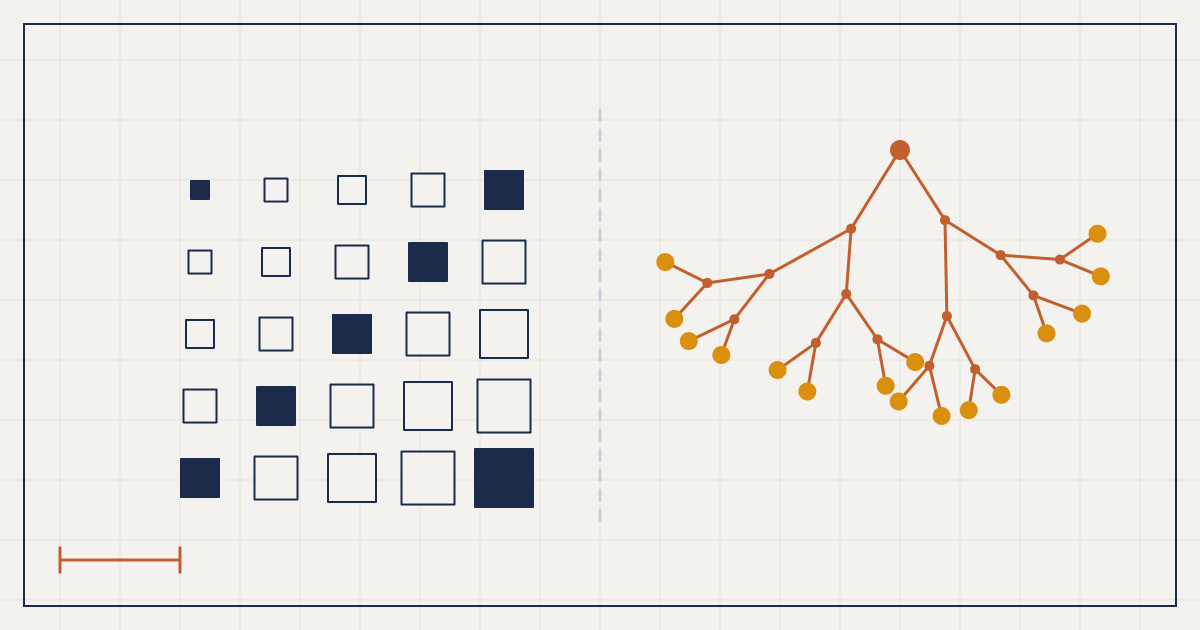
Parametric design drives a design through explicit parameters and relationships you define, so changing an input changes the result predictably. Algorithmic design generates form through coded logic and iteration, often producing results you could not fully predict. Most strong workflows combine both.
Same problems, different methods
Both approaches exist to handle complexity that manual methods struggle with, to automate repetitive work, to optimise performance and to build systems that adapt to changing constraints. Where they differ is in how they get there.
Parametric design: the rule-based framework
In parametric design you define inputs (height, curvature, density, material) and set explicit relationships between them. Change an input and the outcome updates immediately.
- Predefined rules: the designer writes the relationships.
- Real-time feedback: adjust a parameter, see the design respond.
- Visual programming: usually in Grasshopper (Rhino) or Dynamo (Revit).
- Controlled variability: outcomes stay inside the range the parameters allow.
Typical uses: façade shading and airflow studies, structural form-finding for material efficiency, generative zoning from site constraints, and customisable products and furniture.
Algorithmic design: the computational approach
In algorithmic design you write an algorithm, a set of instructions with logic and conditions, and the design emerges from running it. The result may not be directly predictable at the start.
- Emergent form: not limited to pre-defined shapes.
- Iteration: may use genetic algorithms, AI or recursion.
- Adaptability: well suited to complex systems and responsive structures.
- Less intervention: once the logic is set, the designer steers rather than draws.
Typical uses: generative design tools that explore thousands of structural options against stated constraints, adaptive façades that react to light and temperature, agent-based urban layouts, and topology-optimised structures.
Side by side
| Feature | Parametric | Algorithmic |
|---|---|---|
| Approach | Rule-based, predefined relationships | Computational, emergent solutions |
| Input | Parameters set by the designer | Logic that drives form generation |
| Complexity | Moderate, bounded by inputs | High, can be unpredictable |
| Control | Direct and explicit | Indirect and emergent |
| Flexibility | Limited to the parameter set | Highly adaptable and scalable |
| Best for | Customisable design systems | Generative, self-optimising forms |
Why it matters
The hybrid is the future. Use parametric constraints to guide an algorithmic search, and you keep control while gaining computational range.
AI blurs the line. Machine learning is making workflows part rule, part exploration.
Sustainability. Algorithms can reduce waste and optimise material use, while parametric methods make sure the result can actually be made.
Products too. A manufacturer's BIM object is parametric by nature: one object, many sizes, driven by clean parameters. This is why AS 1:2026 rejects "dumb" mesh and requires parametric behaviour for dimensional variants.
Choosing the right approach
For architects and engineers, understanding both is no longer optional. Parametric design offers structured control. Algorithmic design opens up generative creativity. The most effective professionals will blend them, and as computing power grows, design will shift from digital drawing towards systems that help optimise themselves.
Key takeaways
- Parametric: explicit inputs and relationships, predictable outcomes.
- Algorithmic: coded logic and iteration, emergent outcomes.
- Most strong workflows combine both.
- Parametric thinking is also what makes a good BIM product object.
Questions people ask
Is parametric design the same as algorithmic design?
No. Parametric design controls form through defined parameters and relationships. Algorithmic design generates form from computational logic and may produce results that are not directly predictable.
Which tools are used for parametric design?
Grasshopper for Rhino and Dynamo for Revit are common visual programming tools. Many BIM platforms also have built-in parametric families.
Why do BIM objects need to be parametric?
So one object can represent every size and variant of a product without being rebuilt. AS 1:2026 requires native parametric geometry rather than fixed mesh.
Make the data side parametric too
Build the minimum property set for a product, free, and export it as CSV, JSON and an IFC snippet.
Open the data sheet builderKeep reading
The architect and the technologist: why digital skills are now essential
The question is not whether technologists will replace architects. It is whether architects will become technologists.
BIM 101: the principles every designer and engineer should know
BIM is not a tool you install. It is a way of thinking about buildings, and the earlier you get that, the more it pays you back.
BIM for beginners: the first five steps to getting started
BIM looks intimidating from the outside. It is not, if you take it in the right order.